Open post

Solidifying Hanford waste in glass

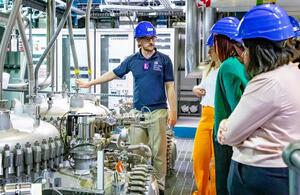
The Hanford site, based in Benton County, Washington, has started up its low-level waste facility where a crucial element of the plant is solidifying the Hanford tank waste in glass.

The Hanford waste treatment plant is designed to safely process 56 million gallons of radioactive waste that is stored in its tanks.

This site was initially used for plutonium production during WWII and the Cold War, and it is now critical that the site addresses its environmental legacy through the plants primary mission to safely treat and stabalise radioactive & chemical waste through a process called vitrification. The waste gets mixed with glass-forming materials and heated to ~2,100 degrees Fahrenheit to create a stable glass form.

“The Hanford Waste Treatment and Immobilization Plant represents a monumental effort in environmental remediation, aiming to mitigate the risks associated with decades of nuclear waste storage. With ongoing advancements and successful operational milestones, the plays a crucial role in the long-term cleanup and safety of the Hanford Site and surrounding communities”

https://www.hanfordvitplant.com/newsroom/the-hanford-site-begins-solidifying-tank-waste-in-glass

Picture from: Hanford Vit Plant
Open post

Aalo-Urenco fuel deal

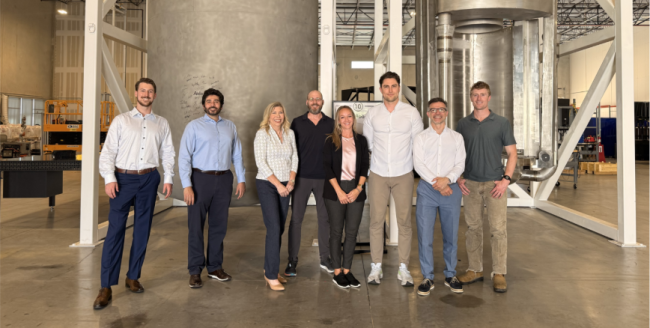
Low-enriched uranium is a must have for Aalo’s, ‘Aalo-X experimental reactor’. Commercially sourced nuclear fuel for a next generation power plant is not something a business in the West has done before.

One of the major fuel enrichment companies in the world, Urenco, operates plants in Europe (Germany, the Netherlands, and the UK), and the U.S. This deal allows Aalo to dodge supply slow down & demand and will help build pace. As an example, SMR developers are having to compete for DOE allocated HALEU (high-assay low-enriched uranium) due to limited domestic production.

Aalo has grand ambitions to build and “deploy hundreds of Aalo pods to power data centers with clean, reliable energy… This strategy lets us focus on scaling reactor manufacturing rather than diverting capital into complex, time-intensive fuel fabrication plants.”

Read more: https://www.aalo.com/post/fuel-duel-with-urenco

Picture: Aalo

Workshop: Nuclear Futures for a Better Tomorrow

We invite you to join us for an innovative, cross-disciplinary workshop on Nuclear Futures, where we will explore four distinct scenarios of how nuclear technologies, policies, and perceptions might evolve in the years ahead.

This is not your typical expert roundtable. We aim to break down silos and bring together people from diverse fields — including scientists, policymakers, creatives, industry leaders, civil society, activists, students, and more — to collaborate on thinking about what’s next for nuclear futures.

What to expect in the workshop

  • Work in an interactive format with people from diverse backgrounds
  • Explore four scenarios of possible nuclear futures
  • Identify risks and opportunities in each scenario
  • Help shape policy recommendations that can support decision-makers in addressing nuclear challenges

Who can apply?

This workshop is for young visionaries eager to explore and shape nuclear futures. We bring together a diverse group of participants to generate fresh ideas, unexpected connections, and balanced perspectives. Places are limited, and selection ensures a rich mix of voices and experiences.

We especially encourage applications from individuals who are often underrepresented in nuclear policy debates.

Once accepted, participation is considered binding, as groups are composed based on profiles. If something unavoidable comes up, please notify us at least 48 hours in advance so your spot can be offered to someone on the waiting list.

Who are we?

We are part of foraus – Swiss Forum on Foreign Policy, a platform enabling young people to actively engage in foreign policy debates and develop political ideas. Through our Nuclear Futures project, we are part of Next Generation Foresight Practitioners (NGFP), an initiative of the School of International Futures (SOIF). SOIF is an international school for futures studies, empowering individuals and organizations to think strategically about the future and make forward-looking decisions. With this project, we aim to empower young people to participate actively in tomorrow’s discussions, contribute their perspectives, and collaboratively develop innovative ideas for the future of nuclear technologies and policies.

✨ Sign up now and help shape nuclear futures with us!


https://www.eventbrite.ch/e/london-youth-foresight-workshop-nuclear-futures-for-a-better-tomorrow-tickets-1778633212819?aff=oddtdtcreator

YGN: The Global Nuclear Fuel Cycle

A 40-minute webinar session, followed by a short Q&A session.
Speaker: Jamie Fairchild, NEA Uranium and Nuclear Fuel Analyst.

Event time: 12:30-13:30

The Global Nuclear Fuel Cycle – Covering:

  • the processing of raw material into fuel
  • the global distribution of these resources and services
  • challenges associated with supporting the current reactor fleet
  • the future deployment of conventional large scale and small modular reactors

Speaker Bio

Jamie has more than 20 years of experience in the uranium exploration, mining, and nuclear energy sectors. Prior to joining the Agency, he was responsible for managing Canada’s uranium and nuclear fuel portfolio for Natural Resources Canada. During that time, Jamie led Canada’s multi-lateral nuclear fuel collaboration efforts and represented Canada as their delegate to the joint NEA/IAEA Uranium Group, including as Vice-Chair. Jamie has also served as Chair of the Bureau for the IAEA’s Convention on Supplementary Compensation for Nuclear Damage during which time he led efforts to operationalise the treaty.

https://nuclearinst.com/Events/ygn-the-global-nuclear-fuel-cycle-opportunities-and-challenges/16163?OccId=22078

Open post

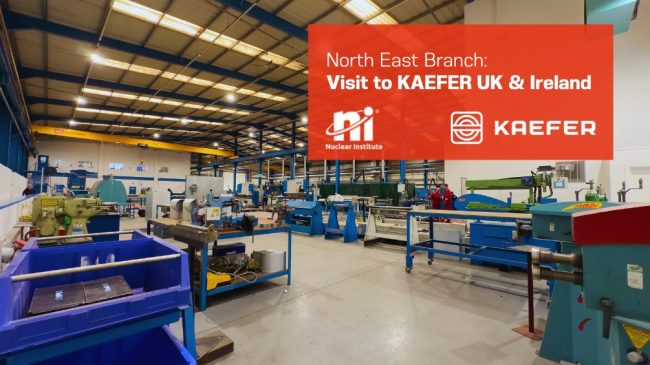
Nuclear Institute, Northeast Branch – Visit Kaefer UK & Ireland

The Nuclear Institute Northeast Branch are delighted to be hosting a site visit to KAEFER UK & Ireland’s Head Office and Fabrication Facility in Jarrow on Thursday 30th October at 14.00.

KAEFER’s fabrication facility is a leader in precision-engineered steel fabrications, ductwork, and HVAC solutions, with over 25 years of expertise. The site employs more than 50 skilled tradespeople and apprentices, supporting sustainable careers in the Northeast and delivering high-quality products across the UK & Ireland.

During the visit, guests will gain an insight into KAEFER’s role in the UK’s nuclear and defence sectors. From manufacturing specialist ductwork for the nuclear island at Hinkley Point C, to supporting the Royal Navy with critical components, the Jarrow facility plays an important part in delivering projects that underpin the UK’s energy transition and national security.

The afternoon will include a presentation and guided walkthrough of the fabrication halls, showcasing KAEFER’s capabilities in plasma cutting, welding, inspection, and quality control – all underpinned by a nuclear safety culture and continuous improvement ethos.

Spaces are limited and early booking via the Nuclear Institute website is advised.

Time: 14:00-17:00


https://nuclearinst.com/events/north-east-branch-visit-to-kaefer/16168?OccId=22083

Picture: Nuclear Institute

Open post

UKAEA funds fusion training with Edinburgh and York universities

£7.8 million investment in master’s degree training will create new opportunities at the University of York and the University of Edinburgh.

  • £7.8 million investment in fusion energy research and training, with further university collaborations in the pipeline
  • Developing the next generation of fusion energy specialists with advancements in level 7 (master’s degree) training
  • Widening participation helps to grow fusion expertise, teaching and capabilities
  • Scholarships will help remove financial barriers for students from a range of backgrounds

The UK Atomic Energy Authority (UKAEA), the University of York and the University of Edinburgh, will invest £7.8 million over the next five years to advance fusion energy research and post-graduate training.

The funding will be distributed through UKAEA’s Fusion Opportunities in Skills, Training, Education and Research (FOSTER) Programme, which aims to develop the next generation of fusion energy specialists.

This investment will create new opportunities across collaborating universities for students to access level 7 (master’s degree) qualifications in fusion and relevant fields, supporting the FOSTER Programme’s mission to build a diverse fusion skills ecosystem.

Nick Walkden, Head of Fusion Skills Operation and Delivery at UKAEA, said:

The UK academic landscape has long been a global leader in fusion education and training at master’s degree level. These new collaborations leverage existing strengths and allow us to build new provision at this level to meet the future demands of the fusion sector as it continues to grow and drive towards delivery of a fusion pilot plant.

The University of York aims to grow its fusion training provision by supporting teaching positions that will deliver new master’s degree programmes. This provision will increase the number of students receiving training in fusion technology and increase research opportunities for undergraduate and PhD students.

The University will provide complementary activities to grow the established Fusion Industry School, and create a new massively open online course (MOOC) that will be available to the public. This will enable people with an interest in fusion to access relevant educational opportunities and discover the potential of working in the UK fusion sector.

Professor Erik Wagenaars, Director of the York Plasma Institute, said:

Our strengths across fusion and plasma science enable this growth; our inclusive research and teaching culture is key to expanding impact across science, and the emerging engineering and technology that will make fusion happen.

The University of Edinburgh aims to apply its expertise in theoretical physics to the challenge of developing and containing fusion plasmas by creating a new Centre for Plasma Theory, bringing together the School of Mathematics and the School of Physics and Astronomy. The University will also develop a fusion stream within existing MSc programmes.

Scholarships to widen access to fusion training will be made available, helping to remove financial barriers for students from a range of backgrounds. The Centre for Plasma Theory will also be a focal point for cross-discipline training and wider engagement activities, preparing young people for fusion careers and helping to increase the UK’s scientific and industrial capacity.

Dr Moritz Linkmann, Director of Graduate School in Mathematics at the University of Edinburgh:

Speaking on behalf of both the School of Mathematics and the School of Physics and Astronomy, we are very excited to enter this new collaboration with UKAEA. It will enable us to develop expertise specific to the sector across disciplines that will inspire and be reflected in our teaching and our research.

The FOSTER Programme aims to build a fusion skills ecosystem with international reach that can train, develop and grow the next generation of fusion experts who will deliver fusion energy to the grid. To do this, it looks to address skills gaps, remove barriers to entry and improve training across all levels of education from primary school through to PhD.

Enhancing and expanding level 7 post-graduate provision is one of the key objectives of the programme. The delivery of fusion-specific teaching will continue to grow as more universities collaborate with UKAEA through this and other FOSTER initiatives in the future.

NIA Nuclear 2025

Nuclear 2025, the industry’s leading annual nuclear conference, is back on Thursday 4 December.

Nuclear 2025 will shine a well-deserved spotlight on a monumental year for the civil nuclear industry. Delegates will hear directly from UK Government, Officials, Union and leading industry representatives and can expect updates on UK nuclear sites and upcoming projects, the nuclear regulatory taskforce, sector growth, nuclear planning and financing, decommissioning and fusion. This is certainly not the year to miss.

This year’s conference will be going to a new venue for 2025, The QEII Conference Centre, along with an exhibition space-allowing you to showcase your capabilities, interact with colleagues and make some new connections.

A Pre-Conference Reception will also take place in the exhibition area on the evening of Wednesday 3 December from 16:30 – 18:30.

Costs
NIA Member – £535 + VAT
Non Member – £710 + VAT
YGN/retired – £285 + VAT
Additional exhibitor – £435 + VAT

NI/NIA Annual Dinner 2025

Held at the prestigious JW Marriott Grosvenor House in Mayfair, London, this is THE premier event for the nuclear industry in the UK, bringing together key players from across the industry, academia, government, legal, commerce, and across the sector.

Attended by 1800+ industry professionals, the NI/NIA Annual Dinner is an excellent opportunity to raise your company’s profile, connect with potential collaborators, bring teams together and network with colleagues.

Organised jointly by the Nuclear Institute and the Nuclear Industry Association, join us to celebrate your achievements over the last year and consider future opportunities for the sector.

https://nuclearinst.com/Events/ni-nia-annual-dinner-2025/16142?OccId=22057

Nuclear Institute – We need to Talk – Better – About Nuclear

An expert review of communication and stakeholder engagement from the Nuclear Industry to the public and other interested parties. This will include historical perspective, current trends and future improvements.

The British public has had a turbulent relationship with the idea of getting energy from splitting atoms. Variously, the nuclear world has been seen as peacemaker, polluter, pioneer and power source. The image of nuclear (in the form of power generator, waste generator or deterrent) is inextricably linked to the worlds of geopolitics, media, environmental issues, public health, risk perception and more.

This talk will summarise how public attitudes to nuclear have changed from the start of the industry in the 1950s to the present day – and the external drivers which have shaped those views. It will also examine how the way the industry communicates (or doesn’t!) can be critical to its future and offer some principles for future good practice.

This is a collaborative event with the Association for Project Management, open to NI members and non-members.

https://nuclearinst.com/Events/central-england-branch-x-apm-we-need-to-talk-better-about-nuclear/16141?OccId=22056

Posts navigation

1 2 3 4 5 6
Scroll to top