Open post

U.S. Control Over Nuclear Fuel Supply Chain

As it stands, U.S. nuclear generators import almost all of their uranium from other countries. Locations include Canada, Australia, Russia, Uzbekistan, and Kazakhstan.

With uranium usage above 32 million pounds, there is a significant opportunity for the U.S. to take a look at their domestic supply chain.

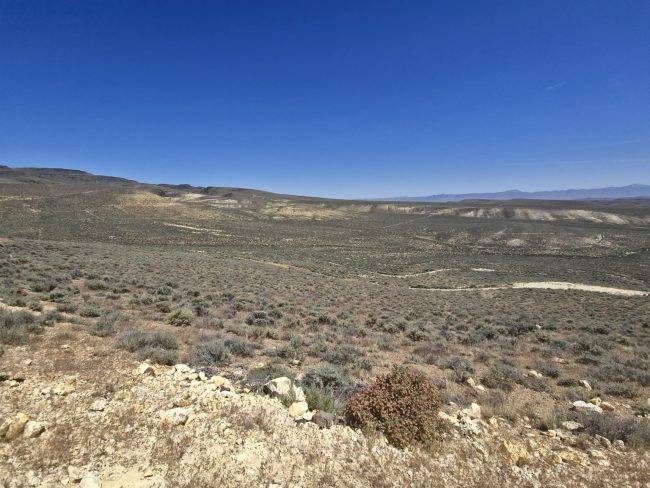
States such as Colorado, Utah, Arizona, Wyoming and New Mexico already have uranium mined areas. Parts of Wyoming, Idaho and Montana have large areas that are not currently being mined, hence the opportunity at hand.

By July 4th, 2026, President Trump wanted to have 3 research & development sites for advanced nuclear reactors identified outside of national laboratories. The president is focused on his ambitions to reform nuclear reactor testing and to deploy nuclear reactor technologies for national security.

The Department of Energy (DOE) also has the high-assay low-enriched uranium allocation program where there have been 5 companies selected for the first-round criteria. The second round supports the testing of advanced reactor designs and the establishment of domestic fuel lines.

More info at the following links; https://www.energy.gov/articles/energy-department-announces-first-pilot-project-advanced-nuclear-fuel-lineshttps://www.eia.gov/todayinenergy/detail.php?id=64444https://www.neimagazine.com/analysis/fuelling-the-future/

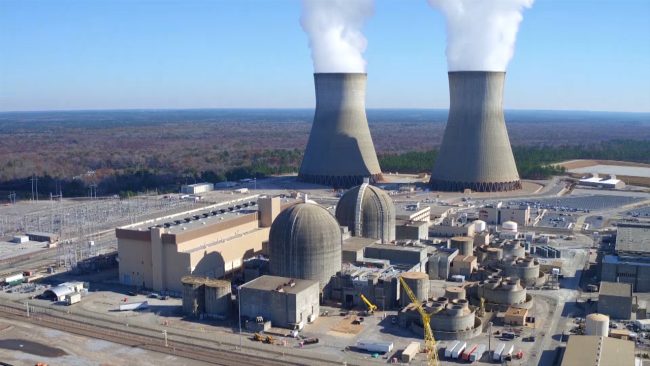
Picture: Georgia Power

Open post

Urenco-EDF Fuel Deal Signed

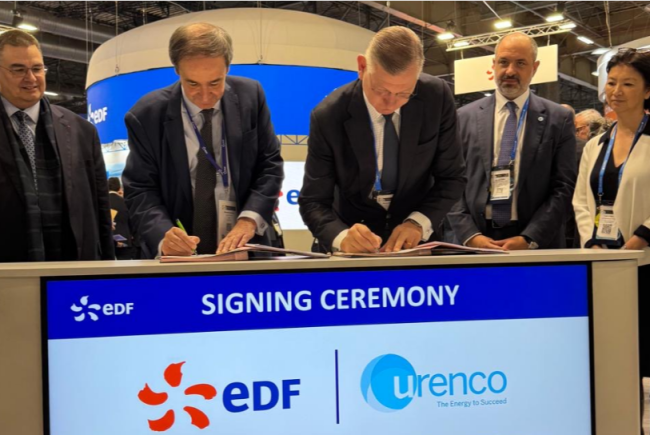
The supply of uranium enrichment services to the UK and France has been agreed between Urenco and EDF during the World Nuclear Exhibition in Paris.

This will support EDF’s fleet into the 2040’s and is a multi-billion-euro agreement. Urenco are a trusted global partner for fuel supply.

Urenco CEO, Boris Schucht said, “This deal represents an enormous step forward for energy security in Europe at a time when it has never been so important in the geopolitical landscape… I am grateful to our long-term partner EDF for once again placing their trust in Urenco.”

What does this mean for the UK?

  1. Long-term security of fuel supply; into the 2040’s over a sustained period which is vital for reliability and resilience.
  2. Minimising reliance on imports; the UK can reduce its dependence on overseas sources, and again, aligning with national energy and supply chain security goals.
  3. A boost for UK enrichment capacity and jobs; enhanced support for Capenhurst with ~1,000 skilled jobs at Urenco’s site, plus strengthening UK domestic infrastructure by reinforcing the nations capabilities.
  4. Continued commitment to low-carbon and green policies; ensuring nuclear remains the backbone of the UK’s clean energy strategy and underpinning the UK’s efforts to decarbonise its nuclear fuel cycle.
  5. Integration with nuclear new builds; Sizewell C will follow a coordinated contract strategy to use the same enriched uranium for its initial years while also deepening industrial links between Urenco, EDF, and DfT.
  6. Economic and strategic independence; a promotion of domestic fabrication (via Framatome UK) for local content and growth, raising value-capture to around 90% (as sited from SZC). Securing uranium enrichment as a pillar of UK energy autonomy and lessening the nations exposure to geopolitical risks.
  7. Lastly, this deal reinforces a Europe-wide focus on shared energy security amid global uncertainty.

Original release; https://www.urenco.com/news/global/2025/urenco-and-edf-sign-fuel-deal-at-world-nuclear-exhibition

Picture: Urenco

Open post

Enriched Lithium: Advanced Nuclear & Fusion Energy

The Hidden Key.

Enriched lithium is a fundamental element for next-generation nuclear energy—integral to both fusion fuel cycles and advanced reactor cooling. Advancing lithium isotope separation technologies and building secure supply chains are critical to unlocking the full potential of fusion and modern fission infrastructures.

The Enrichment Challenge

Historically, lithium isotope separation relied on COLEX (column exchange), a mercury-based process now banned for environmental reasons. Today, the industry is pivoting to cleaner, scalable methods:

  • AVLIS (Atomic Vapor Laser Isotope Separation): Laser-based enrichment with high precision.
  • Electrochemical Separation: Mercury-free, using advanced materials like zeta-V₂O₅ for isotope selectivity.

Companies like Hexium are investing in these technologies to secure supply chains for future nuclear and fusion projects.

Why Lithium Matters in Next-Generation Energy

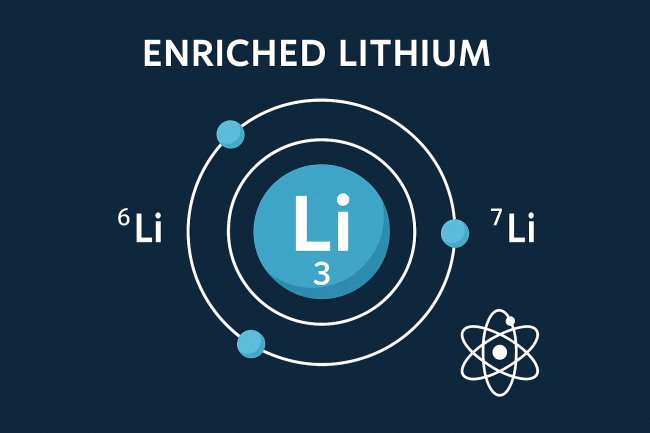
As the world accelerates toward clean energy solutions, enriched lithium is emerging as a critical enabler for both advanced nuclear reactors and fusion power plants. Its unique isotopes—Lithium-6 (Li-6) and Lithium-7 (Li-7)—play distinct roles in fuelling innovation and ensuring operational safety.

Lithium-6: Powering Fusion Through Tritium Breeding

Fusion energy promises limitless, carbon-free power, but it hinges on one scarce resource: tritium. Tritium doesn’t occur naturally in significant quantities, so fusion reactors must breed it internally. This is where Li-6 steps in:

  • Tritium Production: Li-6 reacts with high-energy neutrons inside breeder blankets to produce tritium and helium.
  • Essential for Self-Sufficiency: Without Li-6, fusion plants cannot sustain their fuel cycle.
  • Scale of Demand: A single demonstration fusion plant may require 10–100 tonnes of enriched Li-6, while commercial-scale reactors could need hundreds of tonnes.

Lithium-7: Supporting Advanced Fission Reactors

Li-7 is equally vital for advanced fission technologies, particularly Molten Salt Reactors (MSRs) and Pressurized Water Reactors (PWRs):

  • Coolant Chemistry: Li-7 maintains stable pH in reactor coolants, preventing corrosion and ensuring safety.
  • Molten Salt Reactors: Li-7-enriched salts act as heat transfer media and neutron moderators, enabling high-efficiency designs.

New career pathways are opening up in the nuclear industry. We are passionate that industry and educational institutions collaborate more to ensure people know about emerging careers while we are also working towards meeting future demands.

Open post

Framatome’s Accident Tolerant Fuel Assembly

The first of its kind lead fuel assembly to operate in a commercial reactor has just completed four-years at Constellation Energy’s Calvert Cliffs nuclear power plant in Maryland.

“The performance of our technology continues to demonstrate the expertise of our people to develop safe, cost-effective solutions for our customers and our industry,” said Lionel Gaiffe, senior executive vice president, Fuel Business Unit at Framatome. “The Constellation team has been instrumental in helping us reach this milestone, leading the industry integrating accident tolerant fuel characteristics into their operations.”

“This public-private partnership is helping to drive the fulfilment of national power demands and executive orders issued by President Trump,” said Frank Goldner, the federal program manager for the Accident Tolerant Fuel Program. “This fuel assembly will continue operating under commercial conditions, providing crucial data to support the nation’s energy objectives.”

These fuel tests are aimed at leading towards more economical and performance improvements with the aim being widespread commercial use by 2030.

Sources: https://www.energy.gov/ne/articles/framatome-advanced-fuel-assembly-completes-second-fuel-cycle

Picture: Framatome

Open post

Palisades receives new fuel for restart

The Palisades Nuclear Power Plant in Michigan has reached a key step toward restarting operations by receiving 68 newly manufactured fuel assemblies. This fuel delivery follows extensive planning and regulatory coordination, made possible by the plant’s recent reclassification from decommissioned to operational status by the U.S. Nuclear Regulatory Commission.

Produced by a trusted domestic supplier, the fuel underwent thorough inspection before being securely stored in the Spent Fuel Pool Building, awaiting future installation in the reactor core. Alongside this, major restoration efforts continue across the facility, including the reassembly of the Main Turbine Generator and installation of the final refurbished Primary Coolant Pump motor—both essential for reactor function.

Additional work includes chemical cleaning of the Steam Generators’ secondary systems, following earlier tube refurbishments, to ensure long-term performance. These milestones are part of a broader effort involving over 1,800 workers, supported by government and industry partners, to bring the plant back online and contribute to meeting growing energy demands.

Read the original release: https://holtecinternational.com/2025/10/20/hh-40-22/


Picture courtesy of: Holtec

Open post

Aalo-Urenco fuel deal

Low-enriched uranium is a must have for Aalo’s, ‘Aalo-X experimental reactor’. Commercially sourced nuclear fuel for a next generation power plant is not something a business in the West has done before.

One of the major fuel enrichment companies in the world, Urenco, operates plants in Europe (Germany, the Netherlands, and the UK), and the U.S. This deal allows Aalo to dodge supply slow down & demand and will help build pace. As an example, SMR developers are having to compete for DOE allocated HALEU (high-assay low-enriched uranium) due to limited domestic production.

Aalo has grand ambitions to build and “deploy hundreds of Aalo pods to power data centers with clean, reliable energy… This strategy lets us focus on scaling reactor manufacturing rather than diverting capital into complex, time-intensive fuel fabrication plants.”

Read more: https://www.aalo.com/post/fuel-duel-with-urenco

Picture: Aalo

YGN: The Global Nuclear Fuel Cycle

A 40-minute webinar session, followed by a short Q&A session.
Speaker: Jamie Fairchild, NEA Uranium and Nuclear Fuel Analyst.

Event time: 12:30-13:30

The Global Nuclear Fuel Cycle – Covering:

  • the processing of raw material into fuel
  • the global distribution of these resources and services
  • challenges associated with supporting the current reactor fleet
  • the future deployment of conventional large scale and small modular reactors

Speaker Bio

Jamie has more than 20 years of experience in the uranium exploration, mining, and nuclear energy sectors. Prior to joining the Agency, he was responsible for managing Canada’s uranium and nuclear fuel portfolio for Natural Resources Canada. During that time, Jamie led Canada’s multi-lateral nuclear fuel collaboration efforts and represented Canada as their delegate to the joint NEA/IAEA Uranium Group, including as Vice-Chair. Jamie has also served as Chair of the Bureau for the IAEA’s Convention on Supplementary Compensation for Nuclear Damage during which time he led efforts to operationalise the treaty.

https://nuclearinst.com/Events/ygn-the-global-nuclear-fuel-cycle-opportunities-and-challenges/16163?OccId=22078

Open post

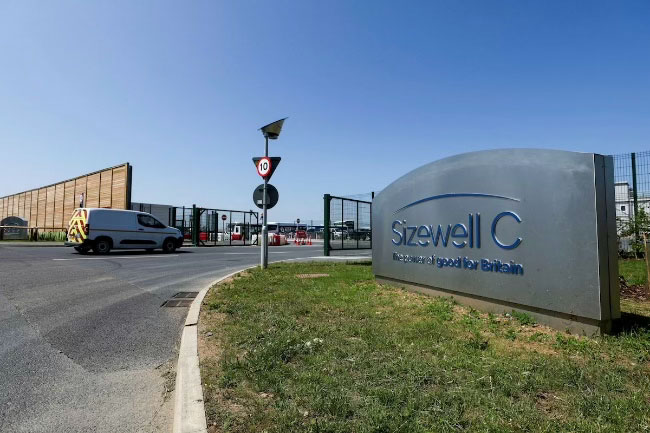
Sizewell C signs fuel contract with Urenco

Urenco has signed a multi-year agreement for enriched uranium services with Sizewell C.

This new contract will support the first six years of the 3.2 GW power station’s operation and will be serviced mainly from our Capenhurst site in the UK.

Framatome has, meanwhile, signed a nuclear fuel fabrication contract with Sizewell, and both mark a major step forward in strengthening the UK’s energy security.

The announcement was made on Monday, October 13.

Urenco CEO Boris Schucht said: “The importance of Sizewell C in the UK’s energy future cannot be underestimated, and Urenco is proud to have been selected as the fuel supplier of choice.

“This will support the millions in economic contributions we make to the UK every year through the enrichment site we have in Cheshire, one of four such sites we have globally, as well as helping to grow skills in the nuclear industry, create jobs and strengthen supply chains.”

See the full announcement here.

Picture from Sizewell C. Story from Urenco

Open post

The nuclear industry is powering up — and new opportunities are emerging across every stage of the fuel supply chain!

BWXT has been awarded a new contract to supply depleted hashtaguranium components — a move that reinforces the strategic importance of strengthening the nuclear fuel supply chain. This award highlights growing investment in advanced fuel cycle capabilities, ensuring the materials and technologies needed to power the next generation of nuclear reactors.

As the industry expands, opportunities are emerging across every part of the value chain — from engineering and manufacturing to logistics, safety, and operations. At Nuclear Careers, we’re helping connect skilled professionals with the organisations leading this transformation.

👉 If you’re ready to plan your talent & skills strategy, we can help.

👉 For candidates interested to play a role in shaping the future of clean, secure energy, now is the time to get involved.

Image credit from above article: https://www.neimagazine.com/
Scroll to top