
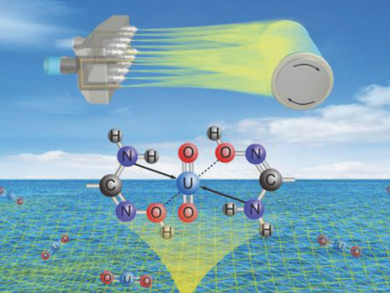
Cropland uranium resources are finite, at today’s consumption rates, terrestrial deposits may last barely a century. But the oceans? They hold approximately 4.5 billion tonnes of uranium, enough to fuel nuclear power for millennia. Unlocking this vast potential demands technological breakthroughs and recent research is lighting the path.
Exploring the Seawater Solution
A recent Springer chapter outlines the challenges and progress in extracting uranium from seawater. Key barriers include ultralow uranium concentration (around 3.3 µg/L), competition from ions such as vanadium, fouling of adsorbents, and efficiency losses under harsh ocean conditions. Amidoxime-functionalised polymers have emerged as the benchmark due to their strong uranium-binding affinity and resilience, but issues remain in scaling up, maintaining high ligand density, and achieving cost-effective, durable sorbents.
Electrochemical Innovation: A Saltwater Harvesting Garage
In a press release from ACS Central Science, researchers report a significant breakthrough using electrocoated cloth electrodes. Carbon-fibre cloth was modified with amidoxime-functionalised polymers, creating a porous matrix that, under cyclic voltage in Bohai Sea water, captured around 12.6 mg U per gram of material over 24 days, three times faster than passive adsorption approaches. This innovation addresses the persistent challenge of surface area and active-site exposure, marrying chemical selectivity with electrochemical kinetics.
Biomimicry at Sea: Inspired by Nature
A team at the Chinese Academy of Sciences drew inspiration from the radial-pore architecture of Chinese sweetgum fruit to develop a hierarchically porous, spherical biomimetic adsorbent. Mimicking natural channels that efficiently transport fluids, the material achieved a 213 % increase in uranium uptake and a 150 % improvement in selectivity over competing ions like vanadium and iron in real seawater tests. Fine-tuning pore size and density based on simulation insights enabled remarkable control over performance.
These pioneering approaches, amidoxime polymers, electrochemical cloth, and biomimetic frameworks, signal a pivotal evolution in nuclear fuel strategy.
- Efficiency Takes the Lead: Biomimetic pore design and electric field-driven adsorption drastically improve mass transport, overcoming decades-old limitations.
- Durability and Regeneration: Reusable sorbents that resist fouling, particularly in salty ocean environments, mark progress toward economically viable deployment.
- Nature-Inspired Innovation: Biomimicry not only accelerates ion access but also enhances selectivity, spotlighting the potential of bio-inspired materials science in energy applications.
- Multidisciplinary Approaches: The fusion of materials chemistry, electrical engineering, and computational modelling exemplifies modern nuclear fuel R&D.
The Broader Implication
Harvesting uranium from seawater isn’t just an academic exercise, it’s a strategic imperative. These technologies promise to decouple nuclear energy from geopolitically volatile terrestrial sources while minimising environmental impact from mining. As uranium scarcity looms, scalable marine extraction could sustain and expand low-carbon nuclear power globally.
For nuclear professionals, these breakthroughs offer a powerful lesson, the future belongs not only to advances in reactor design or regulatory reform, but also to creative, cross-sector synergies where chemistry meets biology, where electrochemistry confronts ocean science, and where ambition meets ingenuity.
Sources; Springer, ACS, Science News Today.
Picture: chemistryviews.org