Nuclear Escalation: Nuclear Weapons Geopolitics in China, India and Asia

Nuclear Institute Central England Branch.

Dev Mistry returns to give an extended and updated version of his excellent Speaking Competition winning talk on the unstable nuclear weapons geopolitical situation in Asia

Talk title: Nuclear Escalation: Assessing the Implications of China’s Nuclear Ambition on India’s Doctrine and Regional Stability in Asia

Synopsis: In the past decade, China has embarked on the fastest nuclear expansion of any recognised nuclear-armed state. Their nuclear arsenal has doubled from approximately 300 warheads in 2020 to an estimated 600 by 2025, with projections suggesting it may exceed 1,000 by 2030. This rapid growth – supported by new silo fields, advanced MIRV-equipped ICBMs, and expanded plutonium production capacities – has raised concerns among global security analysts.

This talk examines how China’s modernisation efforts, including potential doctrinal shifts around its long-standing No-First-Use policy, could increase the likelihood in reshaping India’s nuclear strategy. Although Indian policymakers do not foresee matching China warhead-for-warhead, they are responding by qualitatively strengthening deterrence through longer-range missiles, sea-based platforms, and enhanced readiness measures.

This talk will also explore how China’s expanding capabilities complicate India’s position between its two nuclear-armed neighbours. Historically, India’s doctrine was primarily Pakistan-focused. However, China’s rapid arsenal growth could force India to decouple its deterrence strategies for China and Pakistan. Pakistan may perceive diminished credibility in India’s minimum deterrence and react by expanding its own nuclear posture.

Recent events, including escalation during last May’s Operation Sindoor over disputed territory in Kashmir and its impact on Pakistan’s nuclear signalling, illustrate how fragile the region’s deterrence stability has become. Emerging technologies such as hypersonic glide vehicles further challenge strategic predictability.

This session evaluates whether China’s nuclear trajectory could trigger a new Asian arms race, transform crisis behaviour, and increase the likelihood of miscalculation in what could be one of the world’s most volatile nuclear triangles.

Light refreshments will be provided.
Robotics and Remote Operations for Challenging Environments.

The Central England Branch of the Nuclear Institute is holding their first speaker event of 2026!

Many environments across the nuclear industry and other high-hazard sectors present significant risks to people, driving the need for remote operations and robotic solutions. This talk explores how robotics and remote handling have been deployed to reduce risk and enable inspection, maintenance and intervention in challenging environments, drawing on experience from fusion, fission and wider industry. Using examples from RACE and UKAEA, the talk highlights key principles for designing and delivering remote operations capability, the importance of learning from non-nuclear industries to reduce cost and programme risk, and how behavioural and organisational considerations can be as important as technical capability in driving delivery. While robotics technologies are advancing rapidly, deploying off-the-shelf solutions is often insufficient where critical considerations include long-term reliability, rescue and recovery in the event of equipment failure. The session concludes by considering how these approaches support the delivery of future facilities.

Speaker
Jonathan Snell is the Unit Leader for Remote Handling Operations at RACE, part of the UK Atomic Energy Authority (UKAEA), where he leads engineering and remote handling projects that deliver of robotic systems in challenging environments and support fusion power development. With over 20 years’ experience in engineering and project leadership, Jonathan specialises in deployment of advanced robotics and systems that enable safe, precise operations in nuclear and other extreme conditions — building on decades of UKAEA expertise in remote handling. He holds an MEng from the University of Oxford and is a Chartered Engineer and Member of the Institution of Mechanical Engineers. At RACE, he works at the intersection of fusion technology development, industry collaboration, and real-world application of robotics to support the future of sustainable energy and critical infrastructure.

Light refreshments provided.

An Audience With Change-Makers: Navigating Careers Through Transferable Skills

The event will focus on professionals who have utilised their experience and skills to transfer from other industries into the nuclear sector. Transferable skills are crucial in all areas of the nuclear industry including construction, defence, engineering, waste management and project delivery.

A joint event with the Nuclear Institute & Women in Nuclear Central England Branches.

The link to register will be here soon!

For now, mark this date in your diary and check back early February to register your attendance.

Nuclear Institute Nuclear Professionals Conference

When and where is the conference?

The conference will take place on Thursday 7th May 2026, 9am-4pm in central Manchester. It will be followed in the evening by the Northwest Branch Annual Dinner. 2026 will be the 77th year of this flagship event that regularly welcomes over 600 attendees, allowing conference attendees additional networking opportunities in a social setting.

Who can attend this event?

The conference is aimed at nuclear professionals across all disciplines including science, engineering, business services (such as finance, HR, marketing, IT, project management), students and academics who are interested in their professional development.

Outline agenda

The conference will have 3 keynote talks supported by themed tracks and seven immersive and interactive zones:

  1. Equity, Diversity & Inclusivity Zone: For those committed to EDI, this zone offers practical strategies, bias-busting tools, and discussions on cultural competency and neurodiversity.
  1. Mental Health & Wellbeing Zone: High-pressure environments demand resilience. This zone provides resources, mindfulness sessions, and expert-led talks on managing stress and preventing burnout—critical for sustaining long-term careers in nuclear.
  2. Nuclear Business Services Zone: Explore finance, HR, compliance, and operational excellence. Gain insights into funding models, risk management, and workforce planning.
  3. Career Development Zone: A highlight for those seeking progression. From CV clinics and interview coaching to chartership guidance and CPD pathways, this zone is a one-stop shop for advancing your career.
  4. Technology Zone: Engage with innovations like AI, robotics, VR/AR, and cybersecurity. See how digital tools are reshaping safety, efficiency, and collaboration, and be able to discover opportunities for cross-sector partnerships.
  5. Networking & Mentoring Zone: Structured networking sessions, themed meetups, and mentorship matchmaking. Whether you’re seeking a mentor or offering guidance, this is where lasting professional relationships begin.
  6. Leadership Zone: For aspiring leaders, this zone offers coaching, scenario planning, and strategic insights. Learn from established leaders and develop skills in strategic thinking, crisis management, and inclusive leadership.

Registration and ticket prices

Registration will open in January 2026 and we will email you directly. We recommend signing up to our newsletter as well for first notice of tickets.

NI members of course receive the best ticket rates and we encourage group bookings with bulk ticket options available. Tickets will include Nuclear Institute membership for non-members.

Open post

Nuclear Institute & APM: An Audience with Adrian Bull

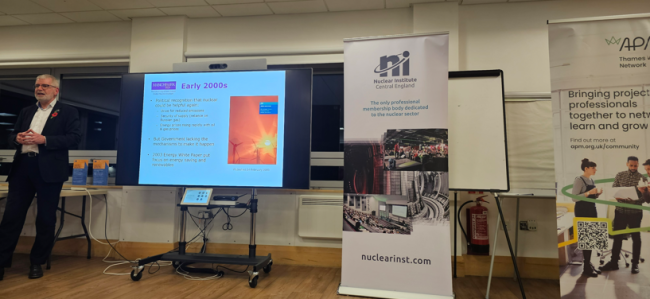
Last night we had the pleasure of joining ~30 other nuclear industry professionals hearing from Adrian Bull who is due to take over the NI Presidency position in January 2026.

Adrian’s background with the Dalton Nuclear Institute, Westinghouse, the BNFL and NNL, mean that Adrian was well-placed to take us on a journey through nuclear.

We were given an interesting insight to the nuclear sector through the ages beginning with the post-war resurgence and technical advancement, through to the present day focusing on nuclear new build, the GDF and SMRs.

A summary of topics:

The 1970’s was a time when the reputation of the nuclear industry was not great mainly due to the Windscale and Three-Mile Island disasters.

During the 1980’s Britain had an enlarged nuclear fleet and the nuclear baseload helped the nation; however, in April 1986 the Chernobyl accident happened. Plans for a fleet of 10 PWRs were thwarted and instead only one was built, Sizewell B.

In the 1990’s, “Dash for Gas” was the was the focus as the electricity supply sector was broken up and privatised. Several Magnox sites were closed while SZB came online in 1995.

Throughout the early 2000’s the government lacked the mechanisms to make nuclear happen and by 2008 there was policy support, but no direct funding route for the sector.

The industry was not without its bad press and, unfortunately, in 2011 the Fukushima disaster happened. While this happened there were different financing models which allowed Hinkley Point C to progress.

The fracking of gas was the main concern for the public and by the 2020’s Sizewell C and SMRs don’t have significant public opposition. Energy security and affordability have become the important topics compared to net zero. The Russian invasion of Ukraine caused high volatility and the GDF siting process sparked local concerns.

In conclusion, it was apparent that the nuclear industry needs to work harder and smarter in the way we communicate. What is the message? What voice do we need to speak in at a given time? What channel do we utilise to spread this message? Who are the audience we are talking to? And, perhaps a good starting point, what outcome are we trying to achieve?

Adrian gave us lots to think about and there were some thoughtful questions during the Q&A at the end of the presentation.

Making an impact: Volunteering in Nuclear with the NI

Discover how you can make a difference by volunteering both within the NI and externally. Whether you’re looking to give back to the industry, your community, or enhance your own skills, there are plenty of opportunities to get involved.

Join this session to learn more about the roles available, the benefits of volunteering, and how you can take the next step.

Speakers:

  • Jordan Hall, YGN Vice Chair
  • Steve Walters, NI Central England branch, and Megan Dean, NI Western branch
  • Helen Hulme, STEM Ambassador
  • Adrian Bull – NI Mentor (and President Elect)
  • Nancy Bellingan – NI Mentor and Mentee

https://events.teams.microsoft.com/event/f0d0b72a-a272-497e-ab82-4fec37ab0127@3c7ef2b6-ed63-4b9f-b68a-e8b9bcdc3971

YGN: The Global Nuclear Fuel Cycle

A 40-minute webinar session, followed by a short Q&A session.
Speaker: Jamie Fairchild, NEA Uranium and Nuclear Fuel Analyst.

Event time: 12:30-13:30

The Global Nuclear Fuel Cycle – Covering:

  • the processing of raw material into fuel
  • the global distribution of these resources and services
  • challenges associated with supporting the current reactor fleet
  • the future deployment of conventional large scale and small modular reactors

Speaker Bio

Jamie has more than 20 years of experience in the uranium exploration, mining, and nuclear energy sectors. Prior to joining the Agency, he was responsible for managing Canada’s uranium and nuclear fuel portfolio for Natural Resources Canada. During that time, Jamie led Canada’s multi-lateral nuclear fuel collaboration efforts and represented Canada as their delegate to the joint NEA/IAEA Uranium Group, including as Vice-Chair. Jamie has also served as Chair of the Bureau for the IAEA’s Convention on Supplementary Compensation for Nuclear Damage during which time he led efforts to operationalise the treaty.

https://nuclearinst.com/Events/ygn-the-global-nuclear-fuel-cycle-opportunities-and-challenges/16163?OccId=22078

Open post

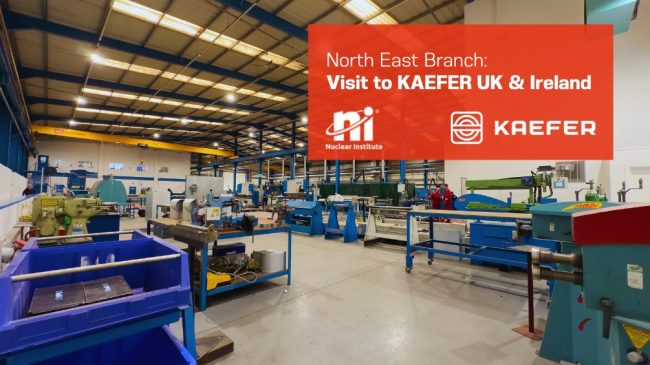
Nuclear Institute, Northeast Branch – Visit Kaefer UK & Ireland

The Nuclear Institute Northeast Branch are delighted to be hosting a site visit to KAEFER UK & Ireland’s Head Office and Fabrication Facility in Jarrow on Thursday 30th October at 14.00.

KAEFER’s fabrication facility is a leader in precision-engineered steel fabrications, ductwork, and HVAC solutions, with over 25 years of expertise. The site employs more than 50 skilled tradespeople and apprentices, supporting sustainable careers in the Northeast and delivering high-quality products across the UK & Ireland.

During the visit, guests will gain an insight into KAEFER’s role in the UK’s nuclear and defence sectors. From manufacturing specialist ductwork for the nuclear island at Hinkley Point C, to supporting the Royal Navy with critical components, the Jarrow facility plays an important part in delivering projects that underpin the UK’s energy transition and national security.

The afternoon will include a presentation and guided walkthrough of the fabrication halls, showcasing KAEFER’s capabilities in plasma cutting, welding, inspection, and quality control – all underpinned by a nuclear safety culture and continuous improvement ethos.

Spaces are limited and early booking via the Nuclear Institute website is advised.

Time: 14:00-17:00


https://nuclearinst.com/events/north-east-branch-visit-to-kaefer/16168?OccId=22083

Picture: Nuclear Institute

NI/NIA Annual Dinner 2025

Held at the prestigious JW Marriott Grosvenor House in Mayfair, London, this is THE premier event for the nuclear industry in the UK, bringing together key players from across the industry, academia, government, legal, commerce, and across the sector.

Attended by 1800+ industry professionals, the NI/NIA Annual Dinner is an excellent opportunity to raise your company’s profile, connect with potential collaborators, bring teams together and network with colleagues.

Organised jointly by the Nuclear Institute and the Nuclear Industry Association, join us to celebrate your achievements over the last year and consider future opportunities for the sector.

https://nuclearinst.com/Events/ni-nia-annual-dinner-2025/16142?OccId=22057

Nuclear Institute – We need to Talk – Better – About Nuclear

An expert review of communication and stakeholder engagement from the Nuclear Industry to the public and other interested parties. This will include historical perspective, current trends and future improvements.

The British public has had a turbulent relationship with the idea of getting energy from splitting atoms. Variously, the nuclear world has been seen as peacemaker, polluter, pioneer and power source. The image of nuclear (in the form of power generator, waste generator or deterrent) is inextricably linked to the worlds of geopolitics, media, environmental issues, public health, risk perception and more.

This talk will summarise how public attitudes to nuclear have changed from the start of the industry in the 1950s to the present day – and the external drivers which have shaped those views. It will also examine how the way the industry communicates (or doesn’t!) can be critical to its future and offer some principles for future good practice.

This is a collaborative event with the Association for Project Management, open to NI members and non-members.

https://nuclearinst.com/Events/central-england-branch-x-apm-we-need-to-talk-better-about-nuclear/16141?OccId=22056

Scroll to top