Open post

Women in Nuclear: Speed Mentoring & Networking

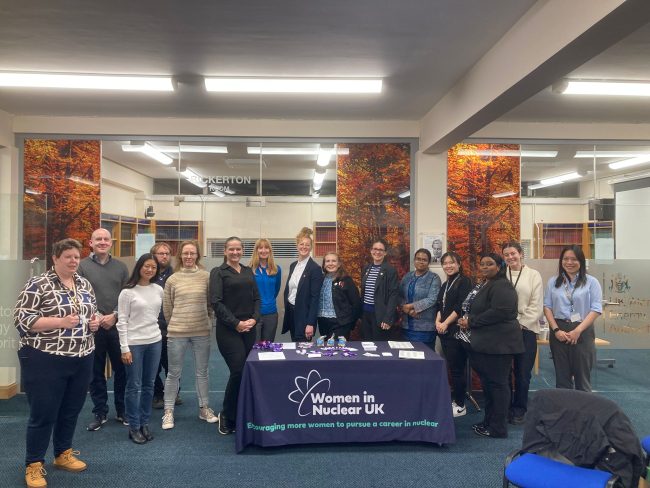
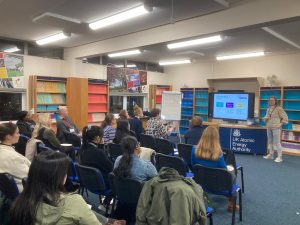
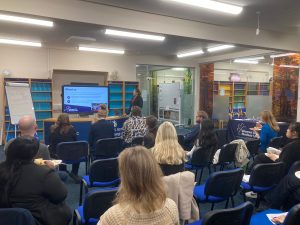
Women in Nuclear (WiN) Central England Branch held a networking and speed mentoring event at UKAEA on the Culham Campus, Oxford, last night (06/11/25).

There were five mentors representing UK Atomic Energy Authority (UKAEA), Nuclear Waste Servies (NWS), Atomic Weapons Establishment (AWE) and Collaborative Environmental Advisors (CEA) with six mentees who all had the chance to talk to all mentors.

Speed mentoring is a great way to introduce both mentor & mentee to each other in short, timed sessions of ~15/20 minutes. Mentees are able to gain insight from each mentor in order to foster quick relationships as opposed to the longer-term commitment of a traditional mentor.

This concept is also valuable for the mentor who gains skills and a development opportunity by talking to different professionals and offering important support.

The evening offered diverse perspectives, a focused learning opportunity, the ability to network during, before and after sessions, and allows a more informal setting than some traditional methods.

Please reach out if you are interested to hear how you can join your local branch of WiN for free! We encourage men and women to join as we want to foster collaboration and allyship in the industry.
Open post

Nuclear Futures for a Better Tomorrow

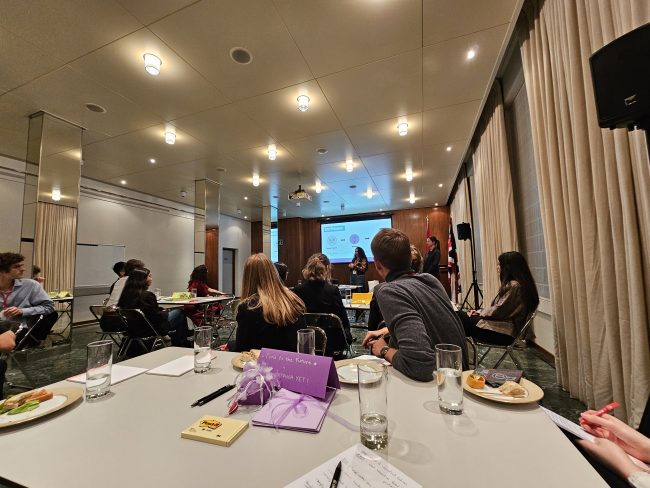
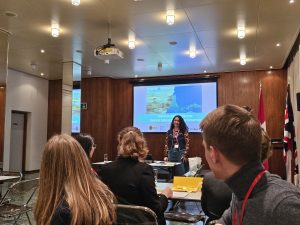
London Youth Foresight Workshop took place on Monday 03/11 and was focused on the nuclear future by exploring 4 different scenarios.

The event was hosted by the Swiss Embassy in London and organised by the School of International Futures (SOIF) and the Next Generation Foresight Practitioners (NGFP).

SOIF is a global non-profit transforming futures for current and next generations and NGFP is a network of over 900 people from all over the world who are using futures and foresight to create positive impact and systemic transformation globally.

The 4 scenarios were Growth: Nuclear Renaissance 2050, Collapse: Nuclear Chaos 2050, Discipline: Nuclear Control 2050, Transformation: Beyond the Nuclear – Regenerative Futures 2050. All thought provoking topics and future scenarios that enabled the ~24 participants to consider & discuss what the nuclear future could look like.

The drivers and trends to consider included, but were not limited to private sector involvement, international collaboration, public education & awareness, intergenerational partnerships, economic interests, technical advancements and the environment.

We were focused within the growth scenario where we explored a future in which nuclear energy gains renewed importance due to increasing energy demands, technological progress and private investments.

Nuclear infrastructure is massively expanded, modular reactors are rapidly developed, and artificial intelligence manages monitoring, safety, and efficiency. National interests and fragmented international cooperation lead to regulatory gaps, while geopolitical tensions and an arms race shape global order.

Public concern about risks and the environmental impacts coexists with the acceptance of nuclear energy; the shortage of skilled workers is addressed through education and knowledge management.

Energy supply, technological innovation, and safety are closely interconnected, yet the system remains vulnerable. A world that grows and renews itself technologically but stays fragile.

We are left contemplating the future we will end up in and found this a really thought-provoking, and interesting workshop to be involved with.

Front Page – School of International Futures
Home – NGFP

Open post

Nuclear Institute & APM: An Audience with Adrian Bull

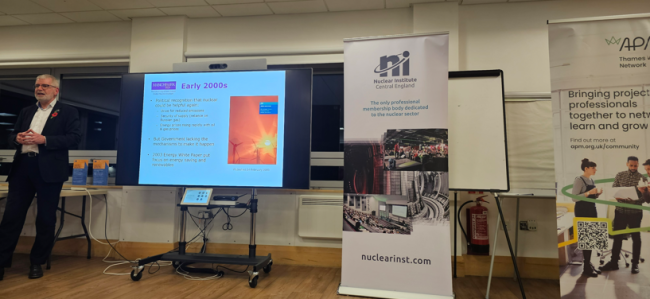
Last night we had the pleasure of joining ~30 other nuclear industry professionals hearing from Adrian Bull who is due to take over the NI Presidency position in January 2026.

Adrian’s background with the Dalton Nuclear Institute, Westinghouse, the BNFL and NNL, mean that Adrian was well-placed to take us on a journey through nuclear.

We were given an interesting insight to the nuclear sector through the ages beginning with the post-war resurgence and technical advancement, through to the present day focusing on nuclear new build, the GDF and SMRs.

A summary of topics:

The 1970’s was a time when the reputation of the nuclear industry was not great mainly due to the Windscale and Three-Mile Island disasters.

During the 1980’s Britain had an enlarged nuclear fleet and the nuclear baseload helped the nation; however, in April 1986 the Chernobyl accident happened. Plans for a fleet of 10 PWRs were thwarted and instead only one was built, Sizewell B.

In the 1990’s, “Dash for Gas” was the was the focus as the electricity supply sector was broken up and privatised. Several Magnox sites were closed while SZB came online in 1995.

Throughout the early 2000’s the government lacked the mechanisms to make nuclear happen and by 2008 there was policy support, but no direct funding route for the sector.

The industry was not without its bad press and, unfortunately, in 2011 the Fukushima disaster happened. While this happened there were different financing models which allowed Hinkley Point C to progress.

The fracking of gas was the main concern for the public and by the 2020’s Sizewell C and SMRs don’t have significant public opposition. Energy security and affordability have become the important topics compared to net zero. The Russian invasion of Ukraine caused high volatility and the GDF siting process sparked local concerns.

In conclusion, it was apparent that the nuclear industry needs to work harder and smarter in the way we communicate. What is the message? What voice do we need to speak in at a given time? What channel do we utilise to spread this message? Who are the audience we are talking to? And, perhaps a good starting point, what outcome are we trying to achieve?

Adrian gave us lots to think about and there were some thoughtful questions during the Q&A at the end of the presentation.

Open post

Cotswold School Career Fair

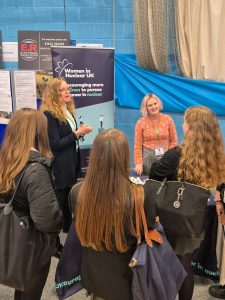
We were in attendance 22.10.25 for the Cotswold School Career Fair with Women in Nuclear (WiN) Central England branch to talk about nuclear careers.

The day offered us the chance to talk with secondary school students in order to spark their interest in careers in STEM.

Many of the students we spoke to were interested to know what they could do with a science, maths or engineering education and what the future career possibilities looked like.

A big focus for us is a broad engineering background as this enables the learner to have a diverse perspective, a transferable skill set and strong foundations to move into a multitude of job functions.

Something to bear in mind for the nuclear sector is the unknown job roles of tomorrow as there are many opportunities ahead of us that are still developing.

So, whether you’re interested in the environment & sustainability, business management, engineering, science, or community engagement, there are a plethora of job functions, careers and opportunities that will suit all individuals.

Open post

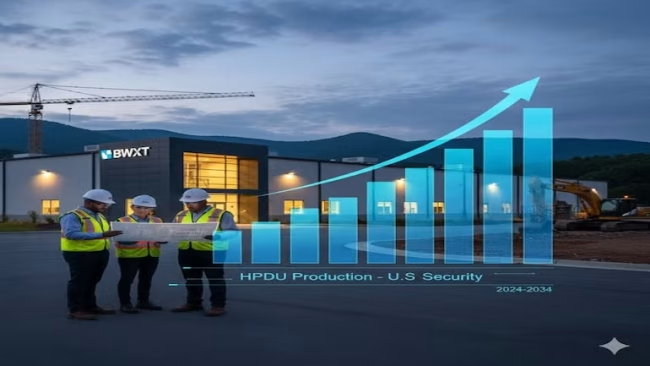
The nuclear industry is powering up — and new opportunities are emerging across every stage of the fuel supply chain!

BWXT has been awarded a new contract to supply depleted hashtaguranium components — a move that reinforces the strategic importance of strengthening the nuclear fuel supply chain. This award highlights growing investment in advanced fuel cycle capabilities, ensuring the materials and technologies needed to power the next generation of nuclear reactors.

As the industry expands, opportunities are emerging across every part of the value chain — from engineering and manufacturing to logistics, safety, and operations. At Nuclear Careers, we’re helping connect skilled professionals with the organisations leading this transformation.

👉 If you’re ready to plan your talent & skills strategy, we can help.

👉 For candidates interested to play a role in shaping the future of clean, secure energy, now is the time to get involved.

Image credit from above article: https://www.neimagazine.com/

Posts navigation

1 2
Scroll to top