
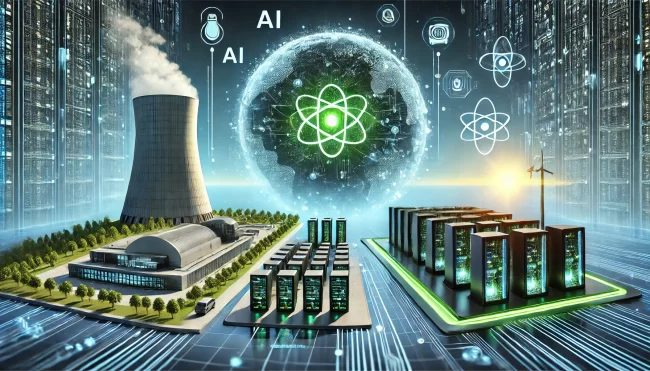
Why Delivery Discipline Will Decide the Winners
Artificial intelligence has accelerated energy demand faster than any previous technology cycle, shifting the bottleneck for digital growth from chips to clean, round‑the‑clock electricity. The tech sector’s pivot toward nuclear power is not a passing headline; it is the logical response to AI’s need for firm, carbon‑free baseload that can be sited near data centres and scaled reliably.
What matters now is execution: turning promising agreements, restarts, and advanced designs into electrons on the grid—on schedule and within budget.
Across the nuclear lifecycle, AI is already reshaping how plants are planned, operated, and decommissioned. The industry has struggled with delays and overruns on first‑of‑a‑kind megaprojects; AI‑driven optimisation tools are starting to change that, allowing developers to simulate thousands of build sequences, stress‑test labour and supply constraints, and re‑plan in real time when conditions shift. This is not abstract theory, it’s being applied to address workforce scarcities, sequencing of safety windows during decommissioning, and dynamic site logistics, with measurable impacts on schedule risk.
The most consequential near‑term trend is the “restart revolution.” Rather than waiting a decade for new capacity, hyperscalers and utilities are reviving retired reactors, combining digital refurbishment strategies with long‑term power purchase agreements to bring firm, zero‑carbon capacity back to the grid.
Google and NextEra’s plan to return Iowa’s 615‑MW Duane Arnold Energy Center to service under a 25‑year agreement is emblematic: existing steel, skilled operators, and proven regulatory pathways reduce risk and compress timelines, while private offtake capital underwrites the restart economics. Similar moves are underway in Pennsylvania and Michigan, signalling a pragmatic, delivery‑first mindset from energy buyers.
Big Tech’s interest goes beyond revivals. Companies are aligning with advanced reactor developers to secure clean, reliable power through the 2030s. Deals to purchase output from small modular reactors reflect a strategic hedge: SMRs promise factory‑built repeatability, smaller site footprints, and potential co‑location near data centres, if licensing and first‑unit delivery stay on track.
The timing mismatch remains real, many AI loads are arriving in the next three to five years, while new nuclear typically needs longer, but the combination of restarts now and advanced builds later offers a credible portfolio approach for hyperscale electricity demand.
Inside operating fleets, AI is raising performance by moving plants from periodic, reactive maintenance to continuous, predictive optimisation. Algorithms trained on sensor streams are catching failure modes earlier, trimming forced outages, and fine‑tuning reactor conditions for efficiency gains measured in fuel savings and megawatt‑hours delivered. Case studies from U.S. reactors show seven‑figure annual benefits per unit from machine‑learning tools that cut analysis time and improve outage planning, practical enhancements that compound across a fleet. These advances are complemented by AI‑enhanced operator training and digital twins that improve response readiness and standardise best practice.
Regulators and policymakers are beginning to treat digital capabilities as core to nuclear competitiveness. Cloud‑native licensing workflows, AI‑assisted design verification, and automated supply‑chain assurance are moving from pilot projects to strategy, but policy frameworks must catch up. Restart pathways, advanced reactor approvals, cyber resilience rules, and export controls were built for an analogue era; adapting them to software‑defined systems will be decisive for national and sectoral competitiveness. The fastest‑moving jurisdictions will not only deploy capacity more quickly; they will also attract talent and capital in the nuclear‑digital nexus.
At the macro level, AI’s electricity appetite is transforming nuclear from a climate‑led aspiration into an economic imperative. Data‑centre load growth is outpacing historic grid planning cycles, and the combination of security, reliability, and decarbonisation has narrowed the list of viable solutions. Leaders in industry and international institutions are now explicit: the scale and speed of AI all but compel a partnership with nuclear if economies want clean, 24/7 power at density and durability sufficient for hyperscale computing. That alignment of incentives; climate, competitiveness, and grid stability, has moved nuclear to the centre of the energy strategy for the AI age.
Still, credibility hinges on delivery. Even with restarts and SMRs, the sector must demonstrate that lessons from past cost escalation have been internalised. This is where AI‑native project controls, digital twins for construction, and integrated workforce planning can become the difference between an on‑time unit and a cautionary tale. AI‑optimised scheduling can surface critical paths and resource clashes early; predictive analytics can manage welding, rebar, and concrete skill bottlenecks; and real‑time dashboards can tie safety windows and security requirements to executable work plans. When applied consistently, these tools don’t just shave weeks—they change the risk posture of nuclear delivery.
For nuclear‑careers.com readers, the career implications are profound. The most valuable profiles will be bilingual across atoms and algorithms—engineers and project managers who can translate between reactor physics, regulatory constraints, and AI‑enabled decision systems. Operators with experience in data‑driven maintenance will lead reliability programmes; licensing professionals versed in digital workflows will unlock permitting speed; cybersecurity experts will harden increasingly software‑centric control systems; and construction leaders comfortable with AI‑guided logistics will own the critical path. This convergence is not a niche; it is the operating model for the next generation of nuclear deployment.
The opportunities extend beyond electricity. As nations explore nuclear‑enabled hydrogen, industrial heat, and desalination, AI will optimise multi‑product operations and dispatch across markets. For utilities, coupling nuclear with AI‑enhanced forecasting and demand flexibility adds further value to firm generation. For communities, restarts offer near‑term job creation and long‑term economic stability; in Iowa, for example, projected benefits from bringing Duane Arnold back online include hundreds of high‑quality jobs and billions in state‑level economic impact, anchored by a technology that aligns with net‑zero commitments.
The bottom line is simple. AI is forcing an honest conversation about energy systems, and nuclear has emerged as the credible backbone for clean, reliable, high‑density power. The next decade won’t be won by press releases; it will be won by delivery discipline, teams that fuse nuclear expertise with AI‑driven planning, regulators that modernise rules for digital realities, and businesses that commit to the long view. Those who execute will set the pace for the intelligence economy. Those who hesitate will be managing shortages. The future of AI will be decided not by microchips, but by megawatts and nuclear is ready to provide them, if we choose to build with precision.
Author’s Note — Laura, Director at Nuclear Careers
We are entering a phase where project delivery expertise will be the defining competitive advantage for countries and companies alike. The talent market is already signalling what comes next; hybrid roles that blend engineering with data science, licensing with digital workflows, and construction leadership with AI‑guided logistics.
If you’re building a career in this field, invest in that bilingual skillset of atoms and algorithms.
If you’re hiring, prioritise teams that can execute at speed without compromising safety.
The AI era will reward those who can turn credible plans into grid‑connected reality.
Sources: neimagazine.com, nuclearbusiness-platform.com, aimagazine.com, www.technologyreview.com, www.cnbc.com
Picture: unite.ai

