Open post

Sellafield & RAICo facility simulator

Virtual Innovation Enhances Nuclear Waste Handling Safety at Sellafield

A cutting-edge simulation project is transforming how nuclear waste is managed at one of the UK’s most hazardous legacy facilities—Sellafield’s Pile Fuel Cladding Silo (PFCS). Originally built in the 1950s, the PFCS is now being decommissioned, with robotic systems playing a vital role in safely handling radioactive waste.

To reduce risk and downtime during upgrades to these robotic systems, RAICo and Sellafield Ltd developed a virtual replica of the facility using advanced 3D scanning, CAD modelling, and RAICo’s RHOVR simulation platform. This digital twin allows engineers to test software and hardware changes in a photorealistic environment before applying them in the real facility.

The result? Fewer human entries into hazardous zones, reduced downtime, and safer, more efficient upgrades to robotic systems. The simulator is already in use at Sellafield’s Engineering Centre of Excellence and could soon be adapted for other waste-handling operations across the site.

This project is a powerful example of how robotics, simulation, and cross-sector collaboration are accelerating innovation in nuclear decommissioning—while keeping people safe and building the digital skills needed for the future.

https://raico.org/a-simulation-of-a-nuclear-facility-makes-it-safer-to-upgrade-waste-handling-robots/

Picture from: RAICo

Open post

ZNPP successfully reconnect Ukraine’s electrical grid

The Zaporizhzhya Nuclear Power Plant (ZNPP) in Ukraine has been successfully reconnected to the national grid after enduring a full month without external power.

This reconnection was made possible through repairs conducted under a locally negotiated ceasefire, facilitated and monitored by the International Atomic Energy Agency (IAEA).

The restored 750 kV Dniprovska power line now supplies the electricity needed to cool the plant’s six inactive reactors and spent fuel, allowing the shutdown of emergency diesel generators that had been sustaining the site.

This marks the tenth—and longest—complete loss of off-site power for ZNPP since the conflict began.

The IAEA praised technicians on both sides of the frontline for their cooperation and resilience in restoring power under challenging conditions.

Further repairs are planned for the damaged Ferosplavna-1 line, with the IAEA continuing to advocate for adherence to its Five Concrete Principles to prevent nuclear accidents, especially the protection of off-site power.

https://www.iaea.org/newscenter/pressreleases/update-323-iaea-director-general-statement-on-situation-in-ukraine


Picture: IAEA / ZNPP / UKRINFORM

Open post

Palisades receives new fuel for restart

The Palisades Nuclear Power Plant in Michigan has reached a key step toward restarting operations by receiving 68 newly manufactured fuel assemblies. This fuel delivery follows extensive planning and regulatory coordination, made possible by the plant’s recent reclassification from decommissioned to operational status by the U.S. Nuclear Regulatory Commission.

Produced by a trusted domestic supplier, the fuel underwent thorough inspection before being securely stored in the Spent Fuel Pool Building, awaiting future installation in the reactor core. Alongside this, major restoration efforts continue across the facility, including the reassembly of the Main Turbine Generator and installation of the final refurbished Primary Coolant Pump motor—both essential for reactor function.

Additional work includes chemical cleaning of the Steam Generators’ secondary systems, following earlier tube refurbishments, to ensure long-term performance. These milestones are part of a broader effort involving over 1,800 workers, supported by government and industry partners, to bring the plant back online and contribute to meeting growing energy demands.

Read the original release: https://holtecinternational.com/2025/10/20/hh-40-22/


Picture courtesy of: Holtec

Open post

Finland is “the most prepared” for fusion

Nordic Fusion Prospects: VTT Report Highlights Best Locations for Pilot Reactor.

A new report by VTT Technical Research Centre of Finland, commissioned by Novatron Fusion Group (NFG), identifies the most promising Nordic locations for a pilot fusion reactor. As fusion energy edges closer to commercial viability, the study evaluates Denmark, Finland, Norway, and Sweden for their readiness to host such a facility.

Key Findings:

  • Finland leads in regulatory preparedness, with reforms to its Nuclear Energy Act expected by 2027.
  • Top candidate regions include:
    • Helsinki metropolitan area (Finland)
    • Stockholm–Nyköping corridor (Sweden)
    • Copenhagen–Malmö region (Denmark/Sweden)
  • Ideal sites are near industrial zones with strong transport links and proximity to research hubs.

The report emphasizes the importance of cross-border collaboration, legislative clarity, and strategic planning to accelerate fusion deployment. NFG’s magnetic mirror reactor concept aims to deliver cost-effective, clean energy, with pilot construction targeted for the 2030s.

Energy company St1 has invested €13 million in NFG, reinforcing the region’s commitment to fossil-free energy innovation.

“Fusion breakthroughs are no longer theoretical,” said Finland’s Climate Minister Sari Multala. “The Nordics are ready to lead.”

Read the full report here.


Picture from: VTT

Open post

Cotswold School Career Fair

We were in attendance 22.10.25 for the Cotswold School Career Fair with Women in Nuclear (WiN) Central England branch to talk about nuclear careers.

The day offered us the chance to talk with secondary school students in order to spark their interest in careers in STEM.

Many of the students we spoke to were interested to know what they could do with a science, maths or engineering education and what the future career possibilities looked like.

A big focus for us is a broad engineering background as this enables the learner to have a diverse perspective, a transferable skill set and strong foundations to move into a multitude of job functions.

Something to bear in mind for the nuclear sector is the unknown job roles of tomorrow as there are many opportunities ahead of us that are still developing.

So, whether you’re interested in the environment & sustainability, business management, engineering, science, or community engagement, there are a plethora of job functions, careers and opportunities that will suit all individuals.

Open post

Solidifying Hanford waste in glass

The Hanford site, based in Benton County, Washington, has started up its low-level waste facility where a crucial element of the plant is solidifying the Hanford tank waste in glass.

The Hanford waste treatment plant is designed to safely process 56 million gallons of radioactive waste that is stored in its tanks.

This site was initially used for plutonium production during WWII and the Cold War, and it is now critical that the site addresses its environmental legacy through the plants primary mission to safely treat and stabalise radioactive & chemical waste through a process called vitrification. The waste gets mixed with glass-forming materials and heated to ~2,100 degrees Fahrenheit to create a stable glass form.

“The Hanford Waste Treatment and Immobilization Plant represents a monumental effort in environmental remediation, aiming to mitigate the risks associated with decades of nuclear waste storage. With ongoing advancements and successful operational milestones, the plays a crucial role in the long-term cleanup and safety of the Hanford Site and surrounding communities”

https://www.hanfordvitplant.com/newsroom/the-hanford-site-begins-solidifying-tank-waste-in-glass

Picture from: Hanford Vit Plant

Open post

NVIDIA & OpenAI announce deployment of 10GW systems

Last month OpenAI & NVIDIA announced a partnership that would see them deploy NVIDIA Systems for OpenAI’s next gen AI infrastructure.

NIVIDA is investing $100 billion to OpenAI where the first phase will come online toward the back end of 2026 using the NVIDIA Vera Rubin Platform.

“NVIDIA and OpenAI have pushed each other for a decade, from the first DGX supercomputer to the breakthrough of ChatGPT,” said Jensen Huang, founder and CEO of NVIDIA. “This investment and infrastructure partnership mark the next leap forward — deploying 10 gigawatts to power the next era of intelligence.”

“Everything starts with compute,” said Sam Altman, cofounder and CEO of OpenAI. “Compute infrastructure will be the basis for the economy of the future, and we will utilize what we’re building with NVIDIA to both create new AI breakthroughs and empower people and businesses with them at scale.”

Read the full story here: https://nvidianews.nvidia.com/news/openai-and-nvidia-announce-strategic-partnership-to-deploy-10gw-of-nvidia-systems

Picture: NVIDIA site

Open post

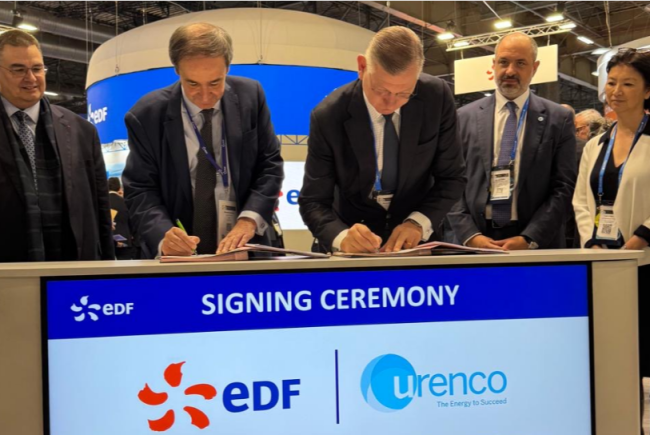
Aalo-Urenco fuel deal

Low-enriched uranium is a must have for Aalo’s, ‘Aalo-X experimental reactor’. Commercially sourced nuclear fuel for a next generation power plant is not something a business in the West has done before.

One of the major fuel enrichment companies in the world, Urenco, operates plants in Europe (Germany, the Netherlands, and the UK), and the U.S. This deal allows Aalo to dodge supply slow down & demand and will help build pace. As an example, SMR developers are having to compete for DOE allocated HALEU (high-assay low-enriched uranium) due to limited domestic production.

Aalo has grand ambitions to build and “deploy hundreds of Aalo pods to power data centers with clean, reliable energy… This strategy lets us focus on scaling reactor manufacturing rather than diverting capital into complex, time-intensive fuel fabrication plants.”

Read more: https://www.aalo.com/post/fuel-duel-with-urenco

Picture: Aalo

Open post

Rolls-Royce Submarines

Rolls-Royce Submarines and global technology company, Siemens, have signed a memorandum of understanding (MOU) to collaborate on digital optimisation and boost efficiency across engineering.

Signed by both parties at the Defence & Security Equipment International event in London in September, the MOU encourages shared and mutual collaboration, with the ultimate aim to minimise time to production for new Rolls-Royce technology, while reducing cost and risk within an increasingly complex engineering, manufacturing and operational environment.

Rolls-Royce Submarines currently employs more than 5,000 people and designs, manufactures and provides in-service support to the pressurised water reactors that power every boat in the Royal Navy’s submarine fleet.

Siemens’ trusted software and hardware from the Siemens Xcelerator open business innovation platform helps companies transform processes – accelerating innovation, improving productivity and enhancing efficiency.

This collaboration with Siemens will support Rolls-Royce Submarines in delivering UK sovereign defence requirements more effectively, enabling a more knowledgeable, productive, secure and agile operation.

The collaboration will benefit from the sharing of best practice across the digital landscape, with the ultimate aim being to enhance skills across engineering, manufacturing, research & development, training and reactor operation and maintenance, using digital technology as an enabler.

http://Rolls-Royce Submarines signs strategic agreement with Siemens to boost digital engineering | Rolls-Royce

Picture: Rolls-Royce

Open post

UKAEA funds fusion training with Edinburgh and York universities

£7.8 million investment in master’s degree training will create new opportunities at the University of York and the University of Edinburgh.

  • £7.8 million investment in fusion energy research and training, with further university collaborations in the pipeline
  • Developing the next generation of fusion energy specialists with advancements in level 7 (master’s degree) training
  • Widening participation helps to grow fusion expertise, teaching and capabilities
  • Scholarships will help remove financial barriers for students from a range of backgrounds

The UK Atomic Energy Authority (UKAEA), the University of York and the University of Edinburgh, will invest £7.8 million over the next five years to advance fusion energy research and post-graduate training.

The funding will be distributed through UKAEA’s Fusion Opportunities in Skills, Training, Education and Research (FOSTER) Programme, which aims to develop the next generation of fusion energy specialists.

This investment will create new opportunities across collaborating universities for students to access level 7 (master’s degree) qualifications in fusion and relevant fields, supporting the FOSTER Programme’s mission to build a diverse fusion skills ecosystem.

Nick Walkden, Head of Fusion Skills Operation and Delivery at UKAEA, said:

The UK academic landscape has long been a global leader in fusion education and training at master’s degree level. These new collaborations leverage existing strengths and allow us to build new provision at this level to meet the future demands of the fusion sector as it continues to grow and drive towards delivery of a fusion pilot plant.

The University of York aims to grow its fusion training provision by supporting teaching positions that will deliver new master’s degree programmes. This provision will increase the number of students receiving training in fusion technology and increase research opportunities for undergraduate and PhD students.

The University will provide complementary activities to grow the established Fusion Industry School, and create a new massively open online course (MOOC) that will be available to the public. This will enable people with an interest in fusion to access relevant educational opportunities and discover the potential of working in the UK fusion sector.

Professor Erik Wagenaars, Director of the York Plasma Institute, said:

Our strengths across fusion and plasma science enable this growth; our inclusive research and teaching culture is key to expanding impact across science, and the emerging engineering and technology that will make fusion happen.

The University of Edinburgh aims to apply its expertise in theoretical physics to the challenge of developing and containing fusion plasmas by creating a new Centre for Plasma Theory, bringing together the School of Mathematics and the School of Physics and Astronomy. The University will also develop a fusion stream within existing MSc programmes.

Scholarships to widen access to fusion training will be made available, helping to remove financial barriers for students from a range of backgrounds. The Centre for Plasma Theory will also be a focal point for cross-discipline training and wider engagement activities, preparing young people for fusion careers and helping to increase the UK’s scientific and industrial capacity.

Dr Moritz Linkmann, Director of Graduate School in Mathematics at the University of Edinburgh:

Speaking on behalf of both the School of Mathematics and the School of Physics and Astronomy, we are very excited to enter this new collaboration with UKAEA. It will enable us to develop expertise specific to the sector across disciplines that will inspire and be reflected in our teaching and our research.

The FOSTER Programme aims to build a fusion skills ecosystem with international reach that can train, develop and grow the next generation of fusion experts who will deliver fusion energy to the grid. To do this, it looks to address skills gaps, remove barriers to entry and improve training across all levels of education from primary school through to PhD.

Enhancing and expanding level 7 post-graduate provision is one of the key objectives of the programme. The delivery of fusion-specific teaching will continue to grow as more universities collaborate with UKAEA through this and other FOSTER initiatives in the future.

Posts navigation

1 2 3 4 5 6
Scroll to top